The best ventilation solution for every barn.
arrow_backTo the overview19 November 2026 | Abbi-Aerotech B.V.
- Energy
- Construction, roads and parks
- Agricultural machinery
- Livestock equipment
- Knowledge and service
- Tools, maintenance and technical equipment
LONGITUDINAL VENTILATION
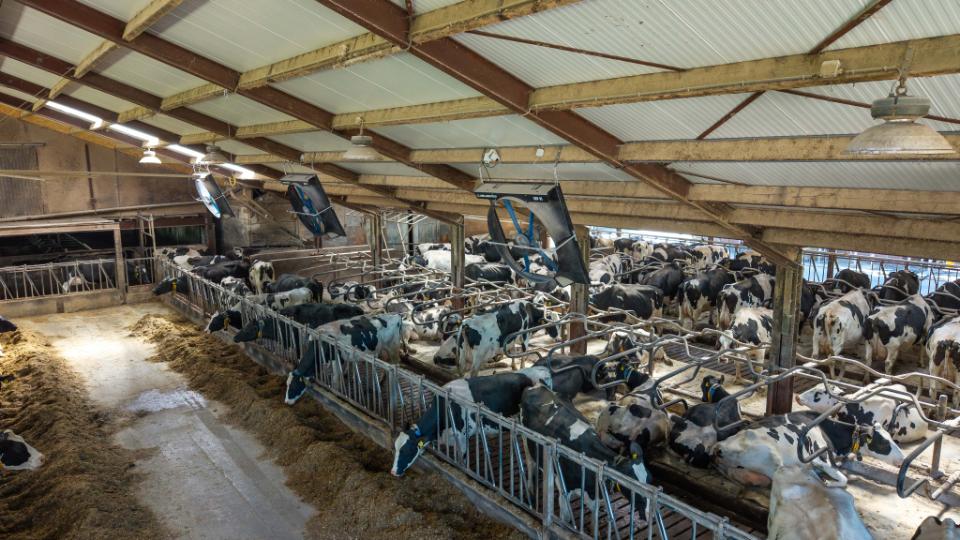
If you cannot implement cross ventilation (because your barn roof is too low, for instance), or you want to cool your cows by just adding air circulation to your barn, then longitudinal ventilation would be your next option to consider.
Here, fans are mounted behind each other along the barn’s length. In contrast to the cross-ventilation concept, fresh air is not actively drawn into the barn.
Tests have shown that for longitudinal ventilation, the best results are achieved when the fans are placed both over the walkway along the feed fence and the cubicles themselves.
As with cross ventilation, the ideal airflow is achieved when the fans run at full speed. The air speed and the fan’s throw determine the distance between the fans in the barn.
VERTICAL VENTILATION
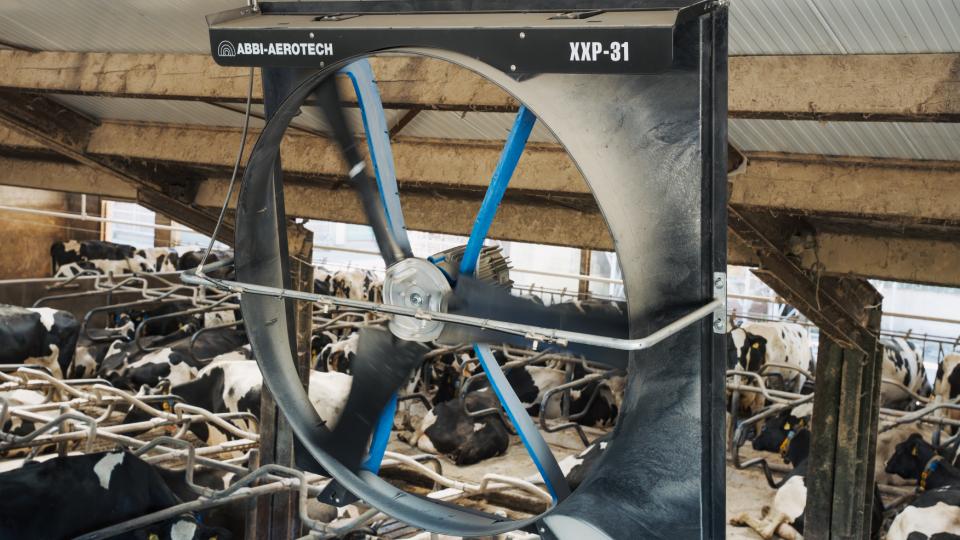
Abbi ceiling fans are characterised by extensive air displacement at low rotational speeds. The fan exerts vertical airflow, ‘pressing’ the air down, as it were. The moment the vertical airflow reaches the floor, the air bounces off the floor surface, generating horizontal airflow in all directions (360°). However, the airflow is affected by any obstacles in the barn, such as cattle, barn layout elements, and walls.
In contrast to Abbifans, the air speed in the direct surroundings of the cattle is much lower and therefore, the cooling
effect is less. A side-effect is that the fans will partially press
down the warmed-up, rising barn air.
The fan is mounted at the height of 4m (13.12ft) to approx.
6.5m (21.33ft) above the floor for optimal operation.
The effective reach of the fan is approximately 1 to 1.5 times the fan’s diameter in all directions when measured from the centre of the rotor.
The maximum interval between ceiling fans should therefore be 3x the fan’s diameter. The rotor’s low rotational speed makes the ceiling fan highly suitable for cooling areas such as group housing/straw-bedding pens, sick pens, and calving pens.

This article is written by:
Abbi-Aerotech B.V.
A better barn climate - Healthier cows - Energy-efficient ventilation
For decades, Abbi-Aerotech B.V. has been designing and manufacturing aerodynamically designed, energy-efficient fans specifically for dairy farming. Our solutions help reduce heat stress, improve air quality and promote animal welfare.
We offer ventilation solutions for different groups of animals and barn types. By combining energy-efficient fans with advanced motor and control technology, we provide solutions adapted to the specific needs of each dairy farm.
Our team brings together expertise in agriculture, engi