Liquid nitrogen fertilizer is an essential tool in the effort to secure both crop yields and the aquatic environment.
arrow_backTo the overview07 October 2026 | DanGødning
The nitrogen debate in Danish agriculture is often reduced to a question of limitations: fewer kilograms of nitrogen, more restrictions, and tighter regulations. However, it might be time to shift our perspective. Instead of solely regulating the quantity, we should focus more heavily on how the nitrogen is applied – and in which form.
Here, liquid fertilizer composed of amide (urea), ammonium, and nitrate – also known as UAN – could prove to be an essential tool. Not only for crop yield, but significantly also for nitrogen retention and, consequently, the aquatic environment.
One of the biggest misconceptions in the public debate is that nitrogen is often treated as a single, homogenous element. Yet, agronomic research is clear: nitrogen behaves very differently depending on its chemical form.
• Nitrate (\(\text{NO}_{3}^{-}\)) is highly soluble and mobile – making it the primary driver of leaching.
• Ammonium (\(\text{NH}_{4}^{+}\)) binds to soil particles and is retained within the root zone.
• Urea (amide) converts gradually into ammonium and subsequently into nitrate, thereby acting as a "buffer."
This distinction is crucial, as it is precisely nitrate that constitutes the main environmental load on groundwater and fjords. And to clarify – there is no difference between organic and conventional nitrate!
Consequently, the question becomes:
Can we manage the form of nitrogen applied to reduce losses?
UAN: An intelligent blend rather than a compromise
Modern plant physiology research demonstrates that mixed nitrogen forms deliver a positive synergistic effect:
• Improved root development
• Increased uptake of both \(\text{NO}_{3}^{-}\) and \(\text{NH}_{4}^{+}\)
• Higher photosynthetic rates
• Enhanced nitrogen metabolism
Furthermore, studies show that single-form nitrogen sources can inhibit uptake, whereas blends optimize the process. This supports the fact that UAN is not merely a technical solution, but a biologically optimized strategy. Liquid fertilizer combining amide, ammonium, and nitrate is therefore not a compromise – it is a proactive strategy that should also be integrated into regenerative agriculture.
Where traditional fertilizer types often deliver nitrogen in one or two dominant forms, UAN provides:
• Immediate effect (nitrate)
• Stability (ammonium)
• Delayed release / slow-release (urea)
The result is a more continuous nitrogen supply tailored to the crop's demands.
Over several years, DanGødning has conducted trials managed by VELAS Field Trials on Lolland, which substantiate that this continuous supply to the crop achieves the highest N-efficiency. Over a 5-year average, the NUE (Nitrogen Use Efficiency) is just above 90% with UAN, compared to approximately 80% using a solid ammonium nitrate fertilizer. The more nitrogen the plant absorbs – the less ends up in the aquatic environment.
Reduced nitrate leaching – the primary benefit
The most environmentally critical aspect remains, and will continue to be, leaching.
Here, UAN plays a central role because:
• A larger portion of the nitrogen is temporarily bound as ammonium
• Urea releases nitrogen gradually
• Soil nitrate concentrations are reduced during critical windows, such as extended periods of heavy rainfall in the early spring
And nitrate is precisely the form that is most easily leached out of the root zone and into the groundwater.
Interplay with nature's own purification processes
When less nitrate leaves the field, nature is better equipped to handle the rest. Wetlands and peatlands act as natural filters, converting nitrate into atmospheric nitrogen through denitrification. However, the system has a tipping point; if the input is too high, it collapses. Therefore, the solution is not just establishing more wetlands – but also reducing the amount of nitrate leaving the field in the first place.
For decades, Danish nitrogen regulation has been dominated by a single approach: restricting inputs. Danish agriculture is well on its way, but it is still possible to:
• Produce more with the same amount of nitrogen
• Improve the management of timing and form
• Further reduce losses through better technology – i.e., precision farming
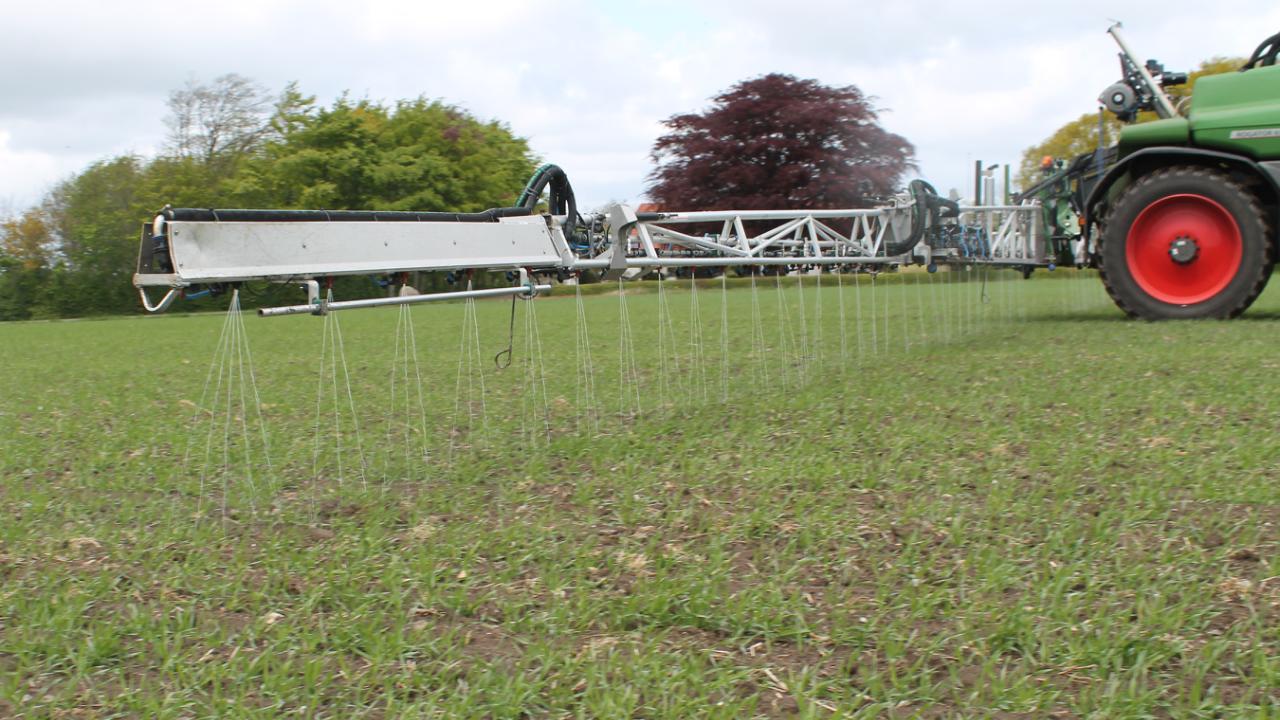
When discussing precision farming, we must not forget that with a liquid sprayer, nitrogen can be applied and variable-rate managed completely accurately across the entire working width, and exactly to the boundary – and only to the boundary – without overspraying onto roads, ditches, sensitive biotopes, etc. The crop's competitiveness against weeds in the outermost meters of the field is also significantly enhanced when the crop receives its full nutrient allocation right up to the edge.
Is UAN a silver bullet? No – but it is a vital tool
It is important to remain realistic. UAN does not solve every challenge:
• Poor timing can still lead to losses
• Weather and soil conditions still play a major role
• Accurate dosing is critical
However, this does not alter the fundamental point: compound nitrogen forms provide better control over the nitrogen flux within the system.
Conclusion: From regulation to optimization
If Denmark is to succeed in maintaining both high food production and a healthy aquatic environment, a new approach is required. We cannot limit the discussion to how much nitrogen we use. We must also focus on how we use it.
Liquid fertilizer containing amide, ammonium, and nitrate proves that solutions exist where:
• The farmer achieves higher efficiency
• The environmental impact is reduced
• Society achieves a better balance
Therefore, this type of fertilizer should not be viewed as a niche product – but as part of the future standard.