Here's how ProGrow is used to save money
arrow_backTo the overview09 October 2026 | SKOV A/S
Despite 25 years of experience, a Swedish pig farmer was missing a tool in his daily routine. He needed faster insight into what was happening in production. That’s why he invested in FarmOnline+ ProGrow.
“I wanted to see my production results much faster and thus avoid having to do manual weighings.”
Today, ProGrow is an integral part of his daily routine. He uses it several times a day to monitor developments in the barn, and one feature in particular has become very important.
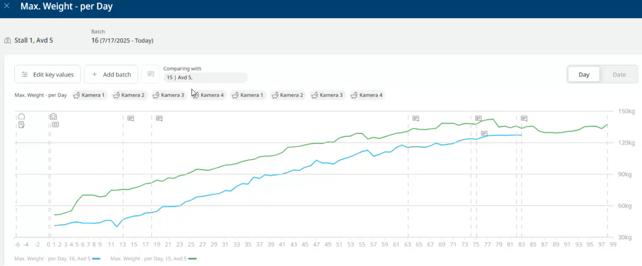
“I check the maximum weight quite often. That way, I know when the pigs are ready for slaughter. Now I send the largest pigs to slaughter earlier. 5–10% used to be too heavy, but that number has dropped. The earlier I sort them, the more I save on feed.”
By monitoring the maximum weight in each pen, he can plan deliveries more precisely, reducing the risk of pigs for slaughter exceeding the weight limit and avoiding unnecessary feed costs.
ProGrow has also helped him detect problems before they cost money. As the number of daily weighings decreased, ProGrow revealed a change in the pigs’ behavior.
“Through ProGrow, we could clearly see a change in their behavior, as the number of weighings dropped drastically. We can tell when something is not optimal and therefore requires an adjustment to the environment.”
Using real-time data, he can monitor developments and make the necessary changes in ProGrow to prevent a larger problem from arising. Another example is daily weight gain. When it dropped, he was able to use ProGrow to link it to a new shipment of feed concentrate. The problem was resolved, and weight gain increased again.
"It turned out that the quality of the new feed concentrate was inadequate. When we changed it, daily weight gain increased as expected."
This demonstrates how real-time data can empower even experienced farmers. When decisions are made based on real-time data rather than gut feelings, it is easier to react quickly, optimize production, and identify the small improvements that make a difference on the bottom line.

This article is written by:
SKOV A/S
SKOV is an industry leader in providing climate control and farm management systems for animal production worldwide. Our systems and services are designed to contribute to efficient and sustainable global food production.
We have been supplying agricultural equipment worldwide for more than 40 years. Our ventilation and farm management systems ensure that animals have a healthy house climate and optimal conditions for their well-being and growth.
SKOV has representative offices in over 20 countries worldwide and subsidiaries in Thailand and the USA. Our headquarters is in Denmark, and we